The principle Idea of the Distillery
Evaporation is a natural process which appears if energy is added to a liquid. If the liquid is a mixture of water and alcohol the alcohol should evaporate earlier because the boiling temperature for ethanol is at 78.3°C (Helmichs, 2018) and for water at 100°C. If the evaporation happens in a closed room and the temperature will be decreased the vaporized liquid should condense at the wall and at the roof. If the condensed liquid can be collected the percentage of alcohol should be higher than in the liquid before evaporation. To get a distillery which only works with solar power the sunlight energy must reach the closed room. I thought in bright and sunny autumn days it is possible to generate a high temperature in a transparent closed room. During night time the temperature decreases so that a condensation should be possible.
The Construction of the Distillery
Figure 1 shows the principal construction of the distillery. As material I chose acrylic glass because it is transparent. As liquid box I chose a black plastic box with dimensions (330*440*270 mm). The idea was that the black colour of the box has a high absorption of the sunlight which generates a higher temperature inside the distillery.
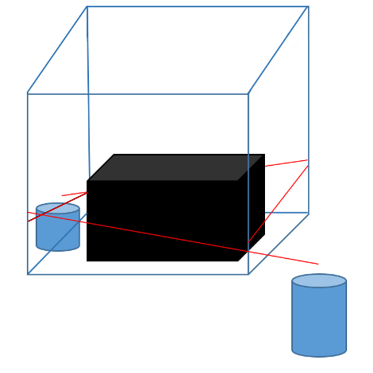
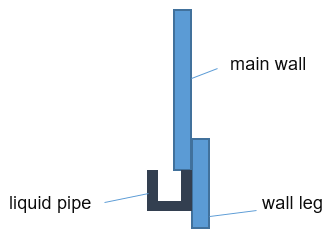
The distillery is based on condensing of alcohol. With a higher temperature it is possible to generate a higher evaporation but for the construction it was necessary to collect as much of the liquid as possible which condensed during night-time on the walls and the roof. To achieve a higher quantity the walls are constructed in two parts. The two parts are called wall leg and main wall.
The red lines in Figure 1 show how the pipes are mounted on each side of the distillery. On the longer side the pipes have an angle of 6° and on the shorter side of 7°. The pipes on the shorter side are mounted in a height that the liquid can drop into the pipes of the longer side. This gives the advantage of having only two output pipes. One at the front right side and one at the back left side as shown in Figure 1. At the end of the pipes which transport the liquid out of the distillery the liquid gets collected by basins like shown in Figure 1. In reality bottles were used to store the fluids. The bottles and the output pipes were connected with tubes to decrease the loss during the transportation process. Together with my father I built up this distillery based on acrylic glass plates of 1 m*1 m with the thickness of 2.5 mm. We cut all the parts with a jigsaw and put them together with special acrylic glass glue. A great challenge was to put all the sides and the roof together to get a stable and a mostly leek proofed distillery. We fixed the sides together with acrylic glass angles which were produced by ourselves by using the thermoplastic effect. For the roof we used a plate which was bigger in the dimension. We chose 500 mm*580 mm. To fix the roof we constructed an angle with additional acrylic glass stripes to position it on the left and back side of the distillery. With additional stripes for the front and right side we fixed the roof completely and got a stable and more or less leek proofed system. See Figure 3.

After the distillery was built we filled up every corner with acrylic glass glue to seal it as good as possible. At some positions of the distillery we had to repeat this process several times until the glue didn’t drop out anymore.
The Start of the Distillery
To start the distillery it was important to have in a short time a useable result. This was the reason why a water boiling test was chosen. For the water boiling test I used a heating plate with a pot of water and placed it inside the distillery. See Picture 1.
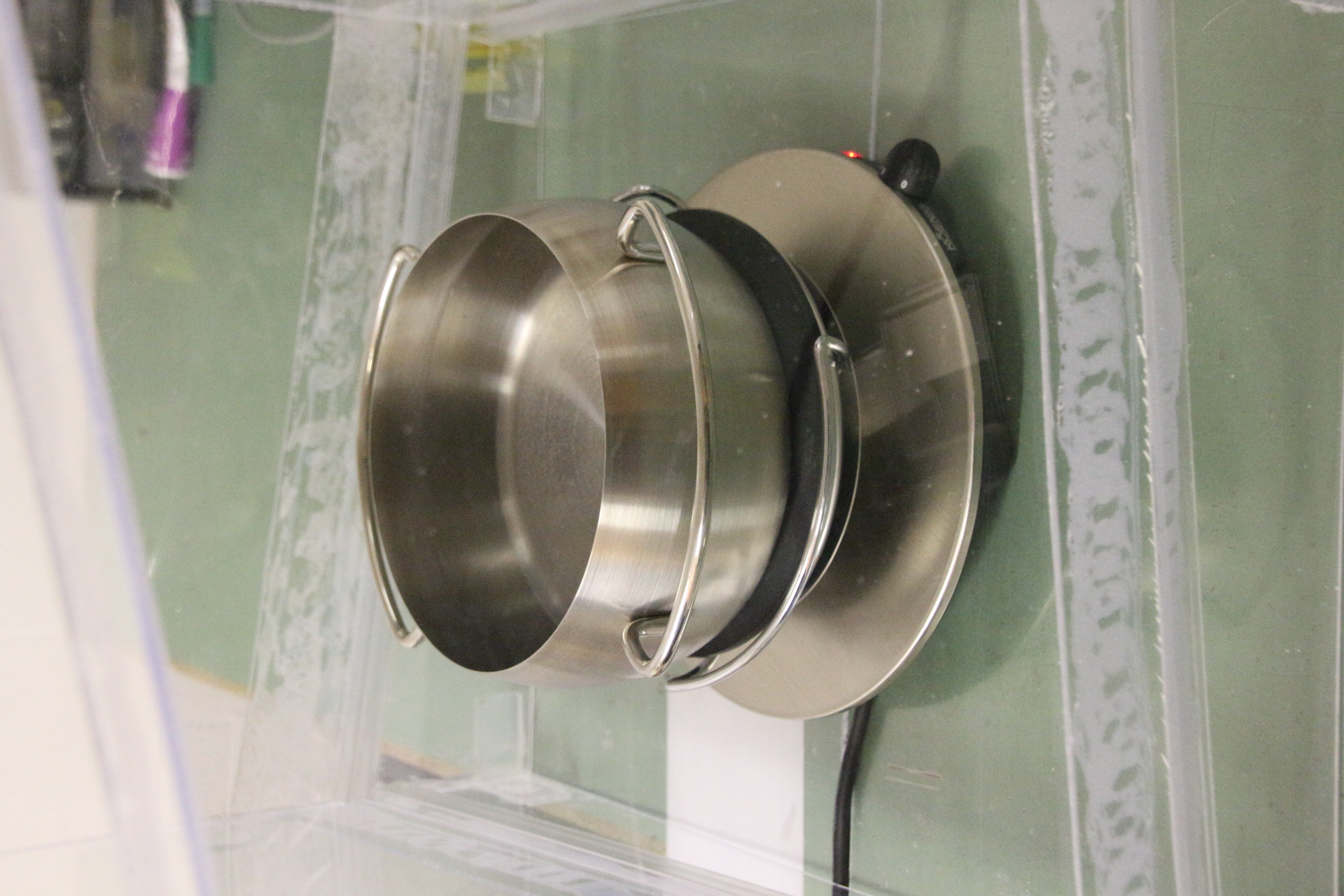
After a certain period of time the water started to evaporate. It was possible to see small drops condensing mostly at the roof of the distillery. The test ran until the condensed water dropped out of the pipes at the front and backside.
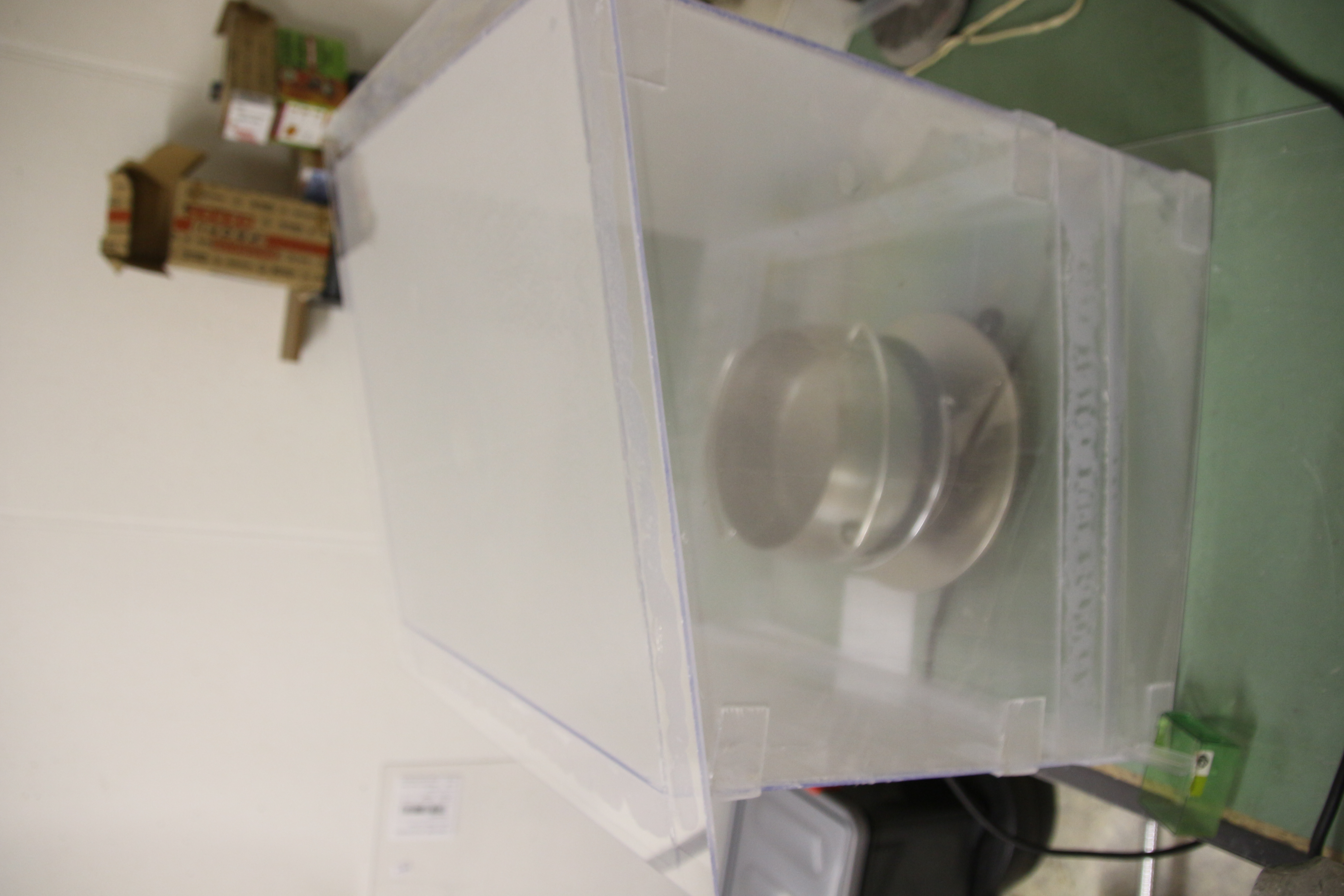
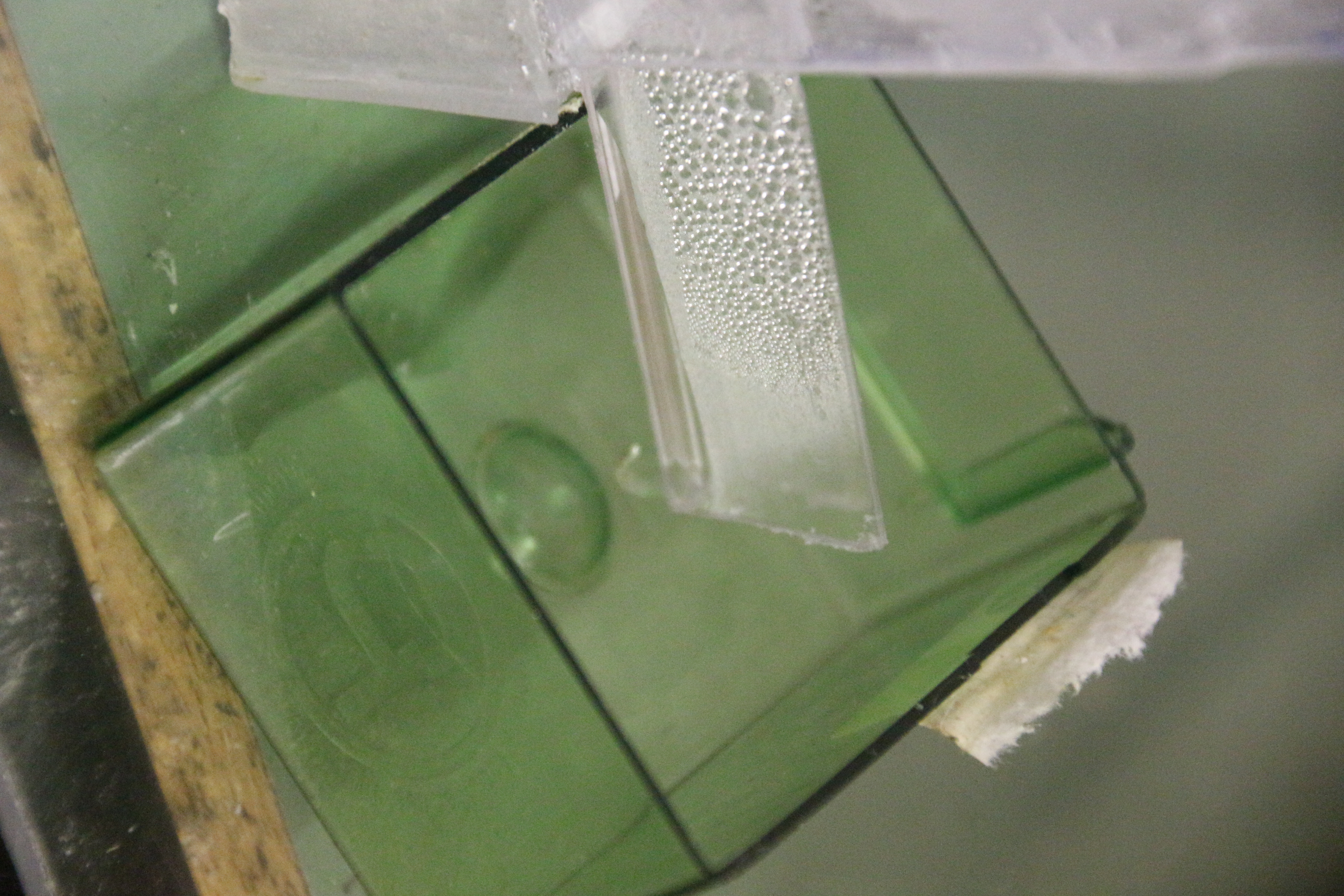
The results of the test were the following:
- No big leakage in the distillery was found.
- The water condensing works.
- The water drops out at the front and at the back pipe.
- The angle of the roof seems to be too flat because a lot of water drops down like rain in the distillery.
- During the water boiling test more liquid comes out at the back output pipe.
There were still outstanding questions: Does this distillery work with solar power and is it possible to get any liquids out of the distillery during a day-night cycle?