The first Test with Sunlight
The first test with sunlight started on the 21st September. I used old liqueurs and other spirits as starting liquid. The fluids mixed together were a brown, sticky mass smelling not very well. The place for this test was outside of the house on the terrace. The distillery was mainly oriented to the south direction at a very sunny place. To increase the steepness of the roof the distillery was shimmed with some wooden shelves. After two sunny days there wasn’t anything inside the bottles. I realized that the sun can’t reach the installation during autumn time. Due to the low altitude of the sun the trees covered the distillery with shadow.
Second Test - new Place
I had to change the location. For a very fast and easy installation and to see if it was possible to get some liquid out of the distillery I put the box onto a chest which was oriented to the south east and should get more sunlight. I wanted to see if this was a better place for the following tests. After one day-night cycle I found the first drops of liquid in the bottles. I was very happy because it seemed that the idea works. After several days there weren’t only drops in the bottle but I got several centilitres see Picture 4.
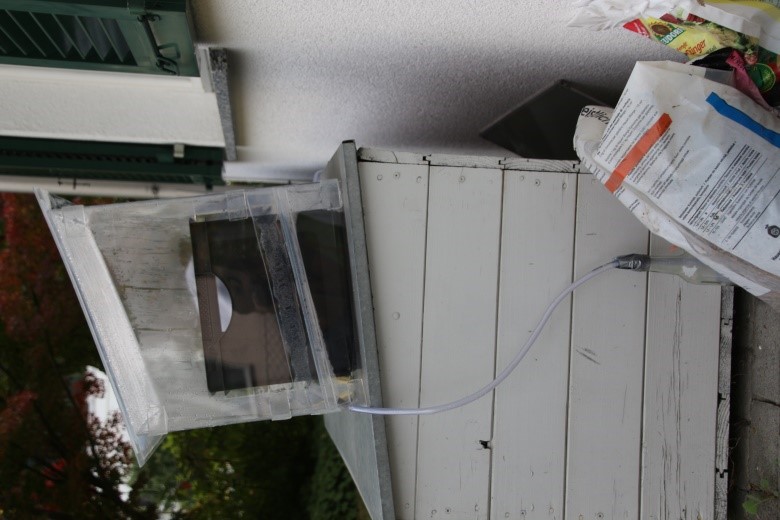
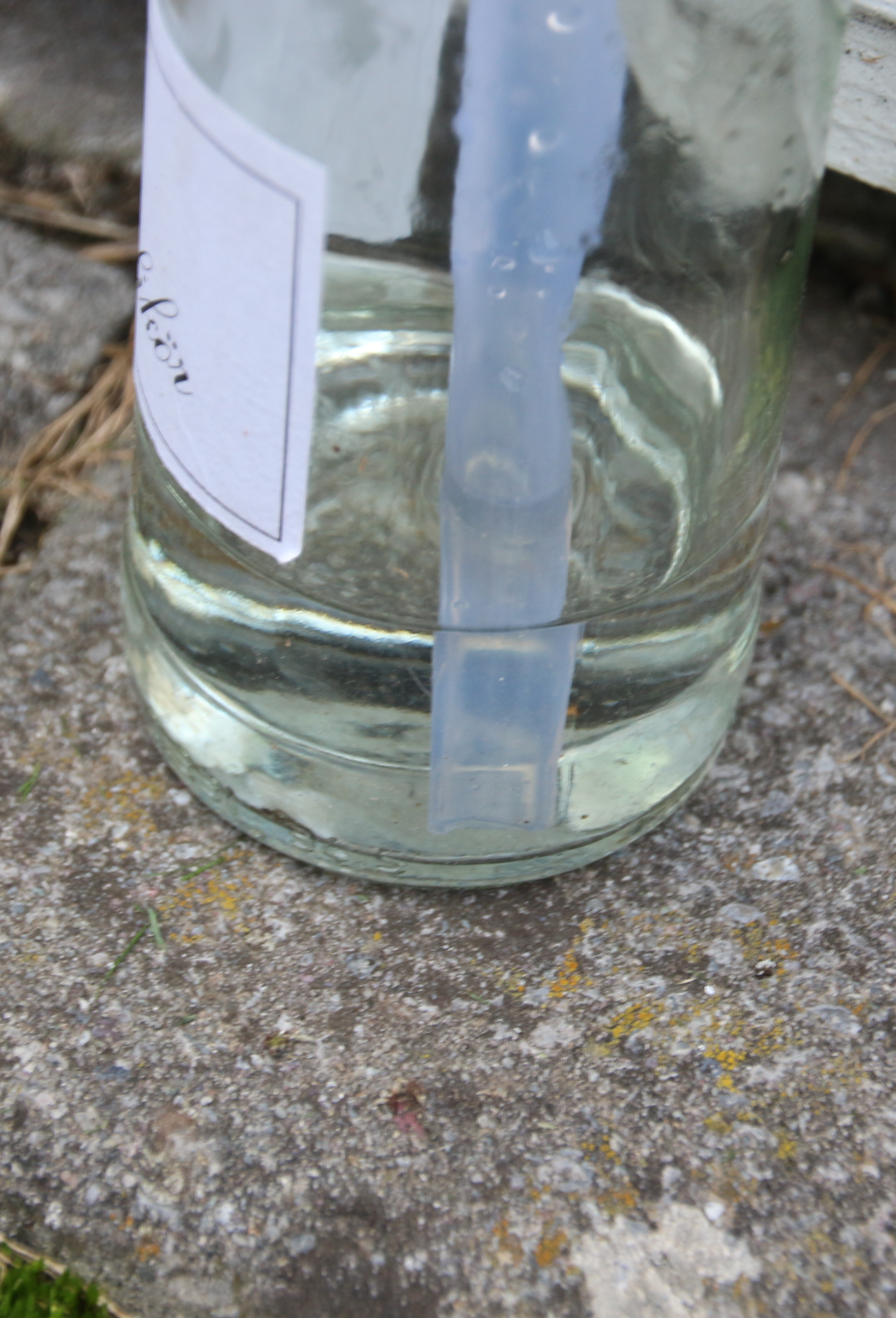
After the analyzation of the new place I understood why the result was much better now than at the first place:
- The new place is sunny from 10 am to 2 pm at the end of September.
- The chest has an angle of 8.75° which gives the roof a steeper inclination and a better orientation to the sun.
- The chest is covered by a metal plate which helps to cool down the inside of the distillery during night-time and generates a higher temperature deviation.
I decided that this new place will be the place for all the next experiments.
Tests with different Wines
After the successful test with a mix of different alcohol liquids I started the real test with wine. I chose wine, because the alcohol concentration is between 11% - 13.5%. If my theory is true that depending on the lower boiling point of alcohol the evaporation of alcohol runs faster the output liquid should have a higher percentage of alcohol than the wine. Following tests were running (see Table 1) including tests of chapter 3.2:
| Test number | Date | Quantity | Sustance |
|---|---|---|---|
| 1 | 21. + 22.09.2017 | unknown about 1 l | Several old spirits and liqueurs |
| 2 | 22. - 28.09.2017 | unknown about 1 l | Several old spirits and liqueurs |
| 3 | 28.09. - 11.10.2017 | 4.5 l | Red wine |
| 4 | 11. - 20.10.2017 | 5 l | White wine |
| 5 | 27.10. - 8.11.2017 | 4.5 l | Red wine |
| 6 | 10. - 28.11.2017 | 5 l | Red wine |
The test 3 started on the 28th September and ran during my holiday trip. Therefore it was not possible for me to monitor the conditions. During the holidays the weather conditions were different. There were some sunny but also some rainy days in Switzerland. The output liquid was clear like water and I didn’t know if the bottles weren’t dense and only filled with rain or if the fluid was alcoholic. After I came back I changed the test liquid to white wine and started test 4 on the 11th October. The following three days I monitored temperature and humidity in the distillery. For the monitoring I used the outside sensor of our home weather station. From the 12th to the 14th October there were always bright and sunny days.
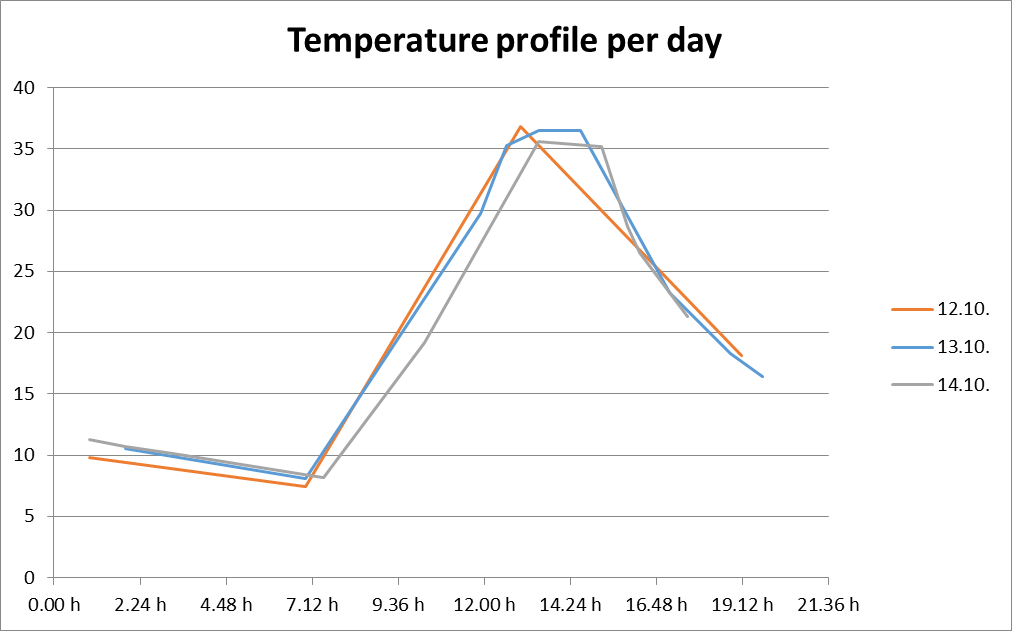
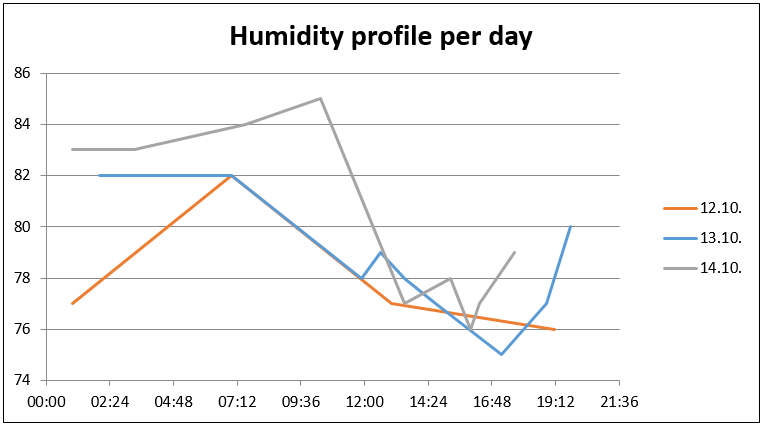
During this test the maximum temperature was 36°C between 12.30 p.m. and 2 p.m. But exactly during this time the humidity decreases. This depends on the physical effect that higher temperature can absorb more moisture. But this takes time and the temperature increases faster. As affect the relative humidity must decrease but the absolute humidity should increase. With a relative humidity of more than 80% during night-time a condensing of the humidity is possible. In these bright and sunny days there was a temperature difference in the distillery of 18°C between maximal and minimal temperature. The minimal temperature was at 7 a.m. the maximal temperature at 1 p.m. The shadow of the house reached the distillery after 2 p.m. After these four tests I made a break because I wanted to discuss the tests and the results with my teacher. We decided to make additional tests to analyse the situation in the distillery a little more. I made test 5 with additional thermometers one in the liquid and one at the wall inside the distillery. I measured the following temperatures during this test, see Table 2.
| Date, Time | Condition | Outside Temp. | Temp. Liquid | Temp. Wall |
|---|---|---|---|---|
| 27.10. 14:00 | sunny | 13.4 | 21 | 18 |
| 27.10. 16:20 | shady | 12.6 | 20 | 12 |
| 28.10. 10:37 | rainy | 9.8 | 6 | 7.5 |
| 28.10. 17:00 | rainy | 11.6 | 7 | 9 |
| 28.10. 18:00 | dark | 11.2 | 7 | 9 |
| 29.10. 9:06 | sunny | 8.7 | 5 | 10 |
| 29.10. 16:38 | shady | 7.7 | 10 | 10 |
| 30.10. 13:02 | sunny | 10.7 | 21 | 18 |
| 31.10. 10:50 | cloudy | 9.4 | 4 | 6 |
| 01.11. 16:38 | shady | 12.1 | 13 | 10 |
Figure 6 shows the behaviour of temperature at different positions during daytime of a sunny October day.

The highest liquid temperature which I could measure during test 5 was 21°C. This depends on the shorter daytime and the lower position of the sun which generates more and more shadow to the position of the distillery. With test 6 I wanted to optimize the distillery a little with covering the back wall of the distillery with black colour. I covered it with black permanent baking paper. The permanent baking paper is a plastic foil and I thought this will have no negative influence of the humidity inside the distillery. Additionally I measured the temperature of the wall, the liquid and of the surrounding during this test. The wall heated up much faster with the black colour but it didn't have a big influence on the liquid temperature see Table 3.
| Date, Time | Condition | Ouside Temp. | Temp. Liquid | Temp. Wall |
|---|---|---|---|---|
| 11.11. 13:00 | shady | 11.4 | 9 | 10 |
| 16.11. 13:00 | sunny | 5.7 | 10 | 18 |
Compared to the temperature results from test 6 Table 3 shows a big difference during a sunny day and cloudy day. The difference of the temperature between test 5 and 6 is described in Figure 7. On cloudy days the black colour didn’t influence the temperature.
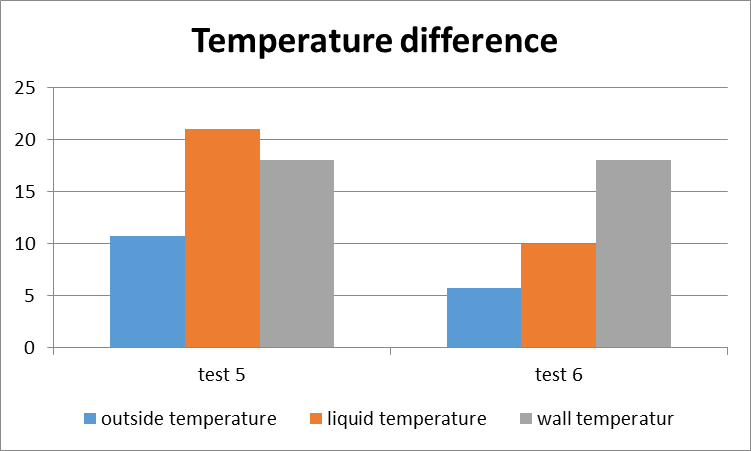
It was much warmer during test 5 than during test 6. During test 6 it was mostly cloudy or rainy. This circumstance reduced the quantity of the outcome see result Table 5. On the 29th November I stopped testing because the outside temperature was too low and the distillery received too less sunlight. It was not possible to get a useful outcome of the distillery without enough solar power.